Encyclopedia / Physiology / Renal
Countercurrent multiplier
The mechanism in the loop of Henle that establishes the medullary osmotic gradient.
The key idea is not that the loop of Henle concentrates the tubular fluid by itself. Instead, it creates an osmotic gradient within the renal medulla. This gradient later provides the driving force for water reabsorption from the collecting duct when its water permeability increases.
Why is it called a multiplier?
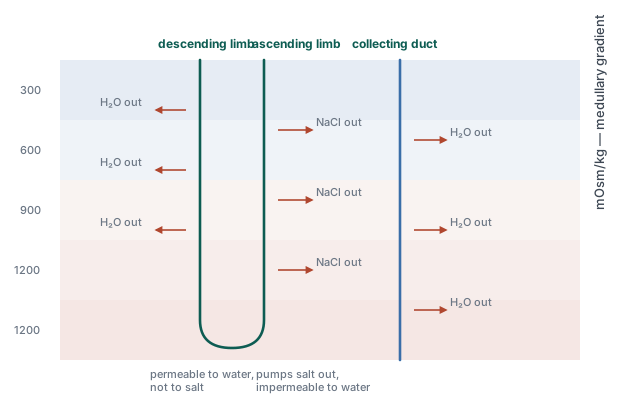
Fluid flows in opposite directions through the descending and ascending limbs. At each horizontal level, only a small osmotic difference is generated. Repeating this along the entire loop converts many small local differences into a large corticomedullary gradient. That amplification is the multiplier.
Functional properties of each limb
| Limb | Water | NaCl | Result |
|---|---|---|---|
| Thin descending limb | Highly permeable | Low permeability | Water leaves, tubular fluid becomes concentrated |
| Thick ascending limb | Impermeable | Active NaCl reabsorption | Tubular fluid becomes dilute, medulla becomes concentrated |
Formation of the gradient
The process begins in the thick ascending limb, where NaCl is transported into the medullary interstitium while water cannot follow, because this segment is impermeable to water. The interstitium therefore becomes more concentrated than the fluid in the adjacent descending limb.
Water then leaves the descending limb by osmosis until equilibrium is approached. Continuous tubular flow brings new fluid into the loop, allowing further NaCl transport in the ascending limb. Repetition progressively establishes a gradient running from the cortex toward the renal papilla.
This is a continuous dynamic process, not a single event.
A common exam mistake is assuming the ascending limb transports water along with salt. Its defining feature is that it is impermeable to water — which is exactly what lets it dilute the tubular fluid while concentrating the interstitium.
Relationship to the countercurrent exchanger
The gradient would be washed out by medullary blood flow were it not for the vasa recta, which act as a countercurrent exchanger. They preserve the gradient rather than generate it.
- The loop of Henle creates the gradient.
- The vasa recta preserve it.
Confusing these two roles is a frequent examination error.
Functional significance
The gradient supplies the osmotic force for water movement out of the collecting duct whenever its permeability rises. Concentrated urine depends first on the gradient existing, and only then on collecting duct permeability.
How to review this
Draw the loop from memory in one minute and label each limb's permeability to water and to NaCl. Then rehearse the sequence in four steps: active NaCl transport → raised medullary osmolality → water leaves the descending limb → continuous flow amplifies it. Finally, check you can separate the roles of the loop and the vasa recta without hesitating.
Terms
| Arabic | English | Latin |
|---|---|---|
| المضاعف المعاكس التيار | Countercurrent multiplier | |
| عروة هنلي | Loop of Henle | Ansa nephroni |
| النخاع الكلوي | Renal medulla | Medulla renalis |
| التدرج الأسموزي | Osmotic gradient | |
| الفرع النازل الرقيق | Thin descending limb | |
| الفرع الصاعد السميك | Thick ascending limb | |
| الأوعية المستقيمة | Vasa recta | Vasa recta |
Get new posts first
One email a week, on studying and the road to surgery.