Encyclopedia / Physiology / Cardiovascular
Cardiac cycle
The sequence of contraction and relaxation that drives efficient blood flow through the heart.
The organizing principle of the cardiac cycle is simple: pressure moves blood, while valves determine its direction. Every phase can be understood by asking two questions: which valves are open, and which chamber has the higher pressure? Once the pressure changes are clear, the sequence becomes logical instead of memorised.
Phases of the cardiac cycle
Each heartbeat consists of five major phases.
| Phase | Atrioventricular valves | Semilunar valves | Main event |
|---|---|---|---|
| Ventricular filling | Open | Closed | Blood flows from atria to ventricles |
| Atrial systole | Open | Closed | Final ventricular filling |
| Isovolumetric contraction | Closed | Closed | Ventricular pressure rises without volume change |
| Ventricular ejection | Closed | Open | Blood is ejected into the aorta and pulmonary trunk |
| Isovolumetric relaxation | Closed | Closed | Ventricular pressure falls without volume change |
Ventricular filling
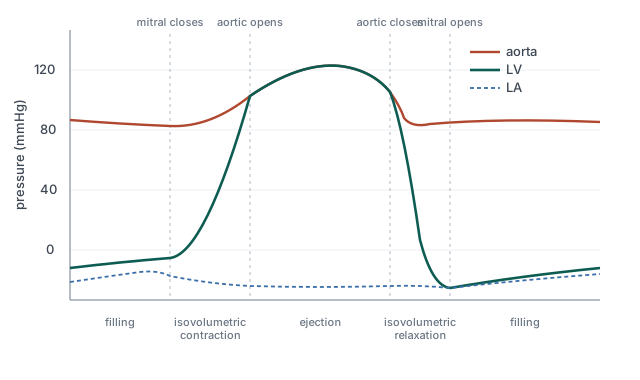
At the beginning of the cycle, ventricular pressure is lower than atrial pressure, allowing the atrioventricular valves to open. Most filling occurs passively, while atrial systole contributes the final portion.
At the end of this phase the ventricle reaches its End-Diastolic Volume (EDV).
Ventricular systole
As contraction begins, ventricular pressure rises rapidly. Once it exceeds atrial pressure, the atrioventricular valves close, producing the first heart sound (S1).
Initially all valves are closed, so pressure increases with no change in volume. This period is isovolumetric contraction.
When ventricular pressure exceeds the pressure in the aorta or pulmonary trunk, the semilunar valves open and ejection begins.
Ventricular ejection
Blood leaves the ventricles through the semilunar valves. The ventricles do not empty completely; a residual End-Systolic Volume (ESV) always remains.
The amount ejected with each beat is:
Stroke Volume = EDV − ESV
The Ejection Fraction (EF) is the percentage of EDV ejected during systole.
A common examination mistake is assuming the ventricles empty completely during systole. Under normal conditions an end-systolic volume always remains.
Ventricular relaxation
After ejection, ventricular pressure falls. When it drops below arterial pressure, the semilunar valves close, producing the second heart sound (S2).
With all valves closed again, pressure continues to fall while volume stays constant — isovolumetric relaxation.
When ventricular pressure finally falls below atrial pressure, the atrioventricular valves reopen and a new cycle begins.
Pressure–volume relationship
Ventricular volume changes only when blood can enter or leave through an open valve. During both isovolumetric phases all valves are closed, so volume stays constant while pressure changes.
How to review this topic
Draw a timeline of the cycle and label each phase with valve status, pressure direction and volume direction. Associate S1 with atrioventricular closure and S2 with semilunar closure. Then derive SV = EDV − ESV from your own diagram without looking at notes.
Terms
| Arabic | English | Latin |
|---|---|---|
| الدورة القلبية | Cardiac cycle | Cyclus cardiacus |
| الانقباض | Systole | Systole |
| الانبساط | Diastole | Diastole |
| الحجم الانبساطي النهائي | End-diastolic volume | |
| الحجم الانقباضي النهائي | End-systolic volume | |
| الحجم القذفي | Stroke volume | |
| الكسر القذفي | Ejection fraction | |
| الصوت القلبي الأول | First heart sound | |
| الصوت القلبي الثاني | Second heart sound | |
| الانقباض متساوي الحجم | Isovolumetric contraction | |
| الارتخاء متساوي الحجم | Isovolumetric relaxation |
Get new posts first
One email a week, on studying and the road to surgery.